
Events tagged with Climate are programs or events that have to do with the Climate Crisis, Climate Justice, and Climate Change Education. Can also have to do with Climate Change related situations and emergencies such as sea level rise, wildfire, drought, heat domes, and flooding.

Tag Archive for: Climate

How can theatre help us imagine, confront, and respond to the climate crisis? Join playwrights Pedro Chamale, Elaine Avila, and Chantal Bilodeau for a conversation about the role of storytelling, performance, and artistic practice in a rapidly changing world. Together, they will explore how theatre can amplify overlooked voices, foster empathy, and inspire action while grappling with the complex realities of climate change. This timely discussion asks what artists can create—and what audiences can learn—when the future of our planet is at stake.


This event will take place in person at the library and be streamed live on Zoom. All registered attendees will receive the Zoom link shortly before the event.

Chantal Bilodeau is a playwright and the founding artistic director of the Arts & Climate Initiative. For the past two decades, she has led projects at the intersection of storytelling and the climate crisis, encouraging artists, students, and audiences to engage in climate action through live performances, talks, publications, workshops, artist convenings, and a worldwide distributed theatre festival. Her plays have been presented in a dozen countries and translated into French, Norwegian, Greek, and Portuguese. Her ongoing project – The Arctic Cycle – is a series of eight plays about the social and environmental changes facing the eight Arctic states. She is currently pursuing a PhD in English at the University of Victoria and is a trainee in the Coastal Climate Solutions Leaders program. In 2019, she was named one of “8 Trailblazers Who Are Changing the Climate Conversation” by Audubon Magazine.


Pedro Chamale (he/him) is a Latiné-Canadian director, playwright, & performer who was born and raised on the unceded, ancestral, and traditional territories of the Treaty 8 Nations, in Chetwynd, BC. He completed the acting program at Douglas College and BFA in Theatre Performance from SFU’s School for the Contemporary Arts. He’s a co-founder and Artistic Director of rice & beans theatre and is a founding member and current board president of CALTAC (The Canadian Latinx Theatre Artist Coalition). Pedro was the Artistic Resident at Neworld Theatre in 2014, the guest curator of the 2018 rEvolver Festival, and was one of the playwrights in the 2019 Playwright’s Lab at the Banff Centre for Arts and Creativity. He was recently the supporting playwright for the 2025 East Van Panto and will be the lead playwright for the 2026 Panto. His play Peace Country was published by Playwrights Canada Press. You can find out more about Pedro’s work at www.pedrochamale.com and www.riceandbeanstheatre.com


A Fulbright Scholar and co-founder of the Climate Change Theatre Action involving 75,000 participants worldwide, Elaine Ávila is described as “a wonderful writer, tremendously gifted, and innovative” (Suzan-Lori Parks), “fully engaged with the immense political, cultural, and aesthetic complexity of fado’s history” (Jeff Parker); her writing as “gorgeous…a piercing cry to the soul” (Katherine Vaz). Her award-winning plays have been produced in over forty cities/countries, from Panamá City to London, Lisbon to Los Angeles. Best New Play Awards include: Jane Austen, Action Figure (Festival de los Cocos, Panamá City), Lieutenant Nun (Victoria Critics Circle), and Café a Brasileira (Disquiet International Literary Program, Lisbon). Her books are available from NoPassport Press and Talonbooks. She is currently commissioned by the Lortel, an off-Broadway theatre, to write about seaweed’s astonishing potential to mitigate the climate crisis and a historic female scientist who founded the first seaside research station in B.C..


This event is also part of Climate Action Week in BC Libraries
Join us for an invigorating talk by Seth Klein on the state of the climate crisis in 2026. How does the climate crisis represent a civilizational threat? What does it look like to move into genuine emergency mode? What is the state of play in Canada and globally? Are we going backwards or forwards? What would it look like to move into genuine emergency mode? Why has climate dropped in public and political attention, and what can we do about it, especially at the local level?


Seth Klein served for five years (2021-2025) as the founder, Team Lead and Director of Strategy of the Climate Emergency Unit (a 5-year project of the David Suzuki Institute). the Climate Emergency Unit’s mission was to initiate joint campaigns and coalitions to advance the emergency policy ideas proposed in Seth’s book. The overarching goal of the CEU was to press for the implementation of wartime-scale policies to confront the crisis, like we tackled an earlier existential threat – the rise of fascism during the Second World War. The project sought to press leaders into genuine emergency mode and to implement policies to dramatically reduce Canada’s greenhouse gas emissions by building coalition tables – federally, provincially, and sectorally – around transformative emergency ideas.
Prior to that, he served for 22 years (1996-2018) as the founding British Columbia Director of the Canadian Centre for Policy Alternatives, a public policy research institute committed to social, economic and environmental justice. More recently, he helped to launch and now serves on the board of the BC Society for Policy Solutions. He is the author of A Good War: Mobilizing Canada for the Climate Emergency (published by ECW press in 2020). He is an adjunct professor with Simon Fraser University’s Urban Studies program.

A social activist for over 40 years, Seth’s activism started as a high school student in the peace movement, and in the anti-racism movement while attending university. He has lived in BC since 1993, and currently lives in East Vancouver. A frequent media commentator on public policy issues, Seth regularly gives talks across the province and nationally. His research deals primarily with climate policy and climate justice, fiscal policy, taxation, welfare policy, poverty, inequality, economic security, and job creation.


This event will be presented in person at the Main Branch. It will also be streamed live via Zoom. Unfortunately, the session will not be recorded. All registered attendees will receive the Zoom link shortly before the event.


This event is co-presented with the New Westminster Climate Action Hub

Are you new to New West or just curious about alternative ways to get around? Are you curious about what life in New West would be like without your car? Join our free Eco-Voyage workshop to learn about different ways to navigate your city including public transit and bike share programs. Learn to enjoy the benefits of multi-modal commutes and gain practical skills and resources to move around safely and sustainably.


Register below to reserve your spot!


This program is held in collaboration with Best Mobility.


Join us to watch this vital and moving film and hear BC women’s stories of climate change, building connections, and moving forward with hope.  The discussion following will focus on ways to increase our own community resilience to climate change.

Join us to watch and have a brief discussion afterwards. Bring a bowl to enjoy the free popcorn provided!

Recommended for ages 13+


As heat domes, atmospheric rivers and wildfires reshape our world, how do we protect what matters most? EMERGENCE: Women in the Storm, from award-winning filmmakers Nova Ami and Velcrow Ripper, goes beyond the headlines to explore how women are navigating climate-based emergencies. Recent disasters, including the wildfire that burned Lytton to the ground and the devastating floods in the Fraser Canyon, Princeton and the Fraser Valley, are seen through the eyes of survivors, while emergency responders and community organizers provide perspectives on preparing for – and moving beyond – the worst. Meghan Fandrich’s reflective readings from Burning Sage: Poems from the Lytton Fire, written after losing her café to the blaze, are woven together with stories of healing, resilience and hope in the face of an uncertain future. Intimate and beautifully crafted, the film offers insights on how to live in this new reality, finding ways to carry on without giving up.

Do you wonder what actually goes on at those international climate conferences? What role do ordinary citizens play? How are voices heard? And whose voices are the ones that shape policy? How can we make sure that justice as at the heart of climate action?

Emilie Smith will be speaking about her four month pilgrimage (by bus, train, boat, burro and bicycle) to last years’ UN climate conference, COP30 in Belem, Brazil. She is also just back from the first conference for the transition away from fossil fuels which happened April 27-28 in Santa Marta Colombia. She was one of four women from the inter-faith sector selected to attend the entire conference, including the high level inter-governmental negotiations.

Emilie is a poet, pilgrim and an Anglican priest (she was the rector of New Westminster’s St. Barnabas from 2013-until March 1 this year). She retired in order to work full-time in coming alongside communities fighting for a new way forward beyond the climate crisis.

Emilie knows that “We are the Answer” to the climate crisis, but has questions about which “we is we”? Come for a stimulating, engaging, thoughtful, and provocative time.


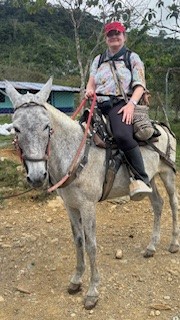
  Emilie on her burro on her COP30 pilgrimage.


This program will be offered in person at the library and streamed online via Zoom. All registered attendees will receive the Zoom link shortly before the program date.

By incorporating nature into our urban infrastructure, we increase biodiversity, and make communities cleaner, greener, healthier, and safer in the face of extreme weather events such as heat domes and atmospheric rivers. We need to move from cities that contain nature to cities embedded in nature. Join us at this informative session to learn about what that means in practise!


Michelle Sheardown is a RegenerateBC facilitator from North Vancouver. She has a professional background in economics, law, and education. Michelle regularly presents on climate solutions to groups on the North Shore, including hosting a monthly session at her local library in Lynn Valley. Michelle enjoys daily walks in the nearby forest with her dog and tending to her rewilded garden.


This presentation will be in person at the library or online via Zoom. All registered attendees will receive the Zoom link.


Join Neill McCallum for a workshop on the essentials and benefits of worm composting—a highly efficient method for creating vibrant, thriving gardens that outperforms traditional composting. Under Neill’s guidance, discover how worm composting produces nutrient-rich vermicompost using household organic waste. Learn to reduce waste, enrich soil biodiversity, and support a flourishing ecosystem through the power of microorganisms.

Watch worms in action and gain hands-on knowledge as Neill provides a detailed, step-by-step guide to building your own affordable worm composting system.

Neill McCallum is a science teacher and environmental educator with a background in Biology and Education, and graduate studies in Education. Neill shares his hands-on experience with vermicomposting, gardening, and being environmentally conscious. Neill is passionate about helping people of all ages better understand where their food comes from and how everyday actions can support healthy ecosystems. His work bridges classroom learning with real-world environmental practices, empowering communities to compost waste, grow food, and care for local biodiversity.


This event will also be streamed live via Zoom. All registered attendees will receive the Zoom link before the session. The session will not be recorded.

What is new and exciting in the world of climate solutions? Recent years have seen huge developments such as global renewable energy production surpassing coal for the first time in 2025. What does this mean for the climate fight? What other good news is there that we are not hearing about in the headlines?

Presenter Dave Hunter will share the latest information on topics such as solar panels, microgrids, geothermal, wind, vertical greenhouses, aquaculture, green bricks, and more, plus a perspective on carbon capture and storage.


Dave Hunter has had an international career working for IBM and other software companies. His science and technology background has equipped him in his retirement to become a facilitator with Regenerate BC working on climate action. He loves the environment, hiking on the North Shore and camping around BC.


Confused about climate change and solutions? Feeling left out of climate conversations? Want to talk about what climate change means for New Westminster? Or how to plan your life or raise your kids in an uncertain future? This is the session for you! Led by Programming Librarian, Caitlin MacRae and Karen Crosby, organizer and leader of the New Westminster Climate Action Hub, this climate café is a space to ask questions, talk about your concerns, possible actions you may take, get connected to community groups or information, and help you feel less alone with this issue. In a relaxed atmosphere we will talk about how we get through our days, what brings glimmers of hope or joy, and how we can come together to help our whole community.

Did you know that a broad majority of Canadians are alarmed or concerned about climate change and that having conversations with our neighbours about climate solutions is one of the best ways to alleviate some of this anxiety? But how do you start those conversations? What if you feel you don’t know enough, or don’t know your neighbours well enough to begin? Join Karen Crosby and Kristen Andrews from the New Westminster Climate Action Hub to learn about how to start. She’ll share best practices for starting solutions-focused conversations and talk about her own journey as a climate communicator.

Here’s to trying new things in the new year and creating community along the way!